CHICAGO — Experienced dry cleaners know that having one person for each job isn’t optimal. Vacations, illnesses or people leaving that job can create a vacuum if there isn’t anyone able to fill in. Because of this, cross-training is vital to ensuring that work goes on even if a valued team member isn’t there.
In Part 1 of this series, we looked at how cross-training programs can be built into the culture of a drycleaning company, as well as deciding who gets trained for certain positions. Today, we’ll continue by exploring ways to train when time is tight while maintaining quality in the end results.
The Timing Problem
Ask any operator what the biggest obstacle to cross-training is, and you will usually hear the same answer: finding the time. When things are busy, nobody wants to pull a skilled worker off the line to teach someone new.
“It’s always a bit of a painful process because you have to slow down and take the time,” says Steve Rettler, president and owner of All Seasons Garment Care & Tailoring in Minneapolis, Minnesota. “But you can’t keep kicking the can down the road. We have staffing challenges all the time. You have to pick those moments when your busy cycle slows down to cross-train people.”
Craig Bamberg, who is co-owner of Platinum Dry Cleaners in Naples, Florida, with his brother, Chris, faces a logistical layer on top of the timing issue. Platinum has two drop stores separated by eight miles, with the production facility between them.
“You’re trying to set up a schedule to do it,” he says, “and you don’t want to break that flow.”
Mike and Janet Garman, who co-own Glyndon Lord Baltimore Cleaners in Glyndon, Maryland, have found that bringing in an outside consultant helps to bridge the gap. The Garmans schedule a consultant visit twice a year for two-week stretches.
“When we bring somebody in, we don’t have to tie up one of our employees,” Mike Garman says. “Also, they’ve seen 50 cleaners in the last year. Sometimes, we might have blinders on so we don’t see an issue that might be there, so it benefits all of us.”
“If you can bring a professional from outside of your organization in to help with the training process, I would highly recommend it,” Janet Garman says. “Usually, people are receptive to working with their co-workers, but sometimes people aren’t, and it validates in their minds more when they’re working with an outside professional.
“Also, it makes them feel special because we aren’t going to waste our resources having them trained by the consultant if we don’t feel like they’re a valuable employee.”
Safeguarding Quality
Putting a trainee on a production station is a calculated risk. Every operator needs a plan for catching mistakes before they reach the customer.
“If we’re training somebody on pants for a day or two, every pair that individual presses gets a colored toggle on the hanger to know who finished it,” Chris Bamberg says. “They’re set aside. Then the finishing manager will walk over, look at them and correct whatever needs to be corrected. And we have an ex-finisher on the assembly line who’s got the authority to bring it back to any finisher and say, ‘This doesn’t meet our quality standards.’”
Rettler relies on communication between trainees and the inspection team.
“Everything funnels to a quality control person,” he says, “and through good communication, we let them know what’s going on, what they need to look for and to heighten their attention to detail.”
The Garmans have built a culture where quality is everyone’s responsibility.
“We’ve said to our team, ‘You can be walking past a shirt that’s on the rail, and if you don’t think it looks good, you take it back to the shirt department,’” Janet Garman says. “No one should be offended or bothered because we’re all in it together.”
Monthly team meetings at Glyndon Lord Baltimore include a redo report that breaks down returns by category, helping the Garmans spot trends and tighten up where needed.
The Toughest Seats
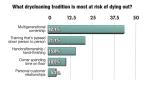
Some jobs transfer more easily than others, but inspection and quality control are some of the hardest roles to cross-train.
“There are so many types of garments that it’s imperative you’re able to recognize what it’s supposed to look like,” Rettler says. “And if there’s still a spot on the garment, you have to be able to take it back to the people responsible for making it look better and confront them. Those are tough roles to cross-train.”
He also points to spotting as a position where on-the-job experience is almost impossible to replicate in a quick training session.
“A trained spotter knows all kinds of tricks,” he says. “If you don’t have that skill set, you just can’t do the job well. There’s so much knowledge and on-the-job training built into that position.”
For the Bambergs, the high-end couture station is the sensitive one.
“You need a lot of patience because there’s more hand-finishing,” Chris Bamberg says. “You’re pulling out and hand-pressing pockets on higher-end pants. It takes more attention to detail than just a regular, everyday golf shirt and a pair of Dockers.”
Craig Bamberg says even the marking room can be tricky when you position yourself as a high-end cleaner.
“A blouse just isn’t a blouse when you consider yourself the high-end couture cleaner in Naples, Florida,” he says. “You’ve got to give an education in designer clothing. We put this garment to the side because we’re not going to use that cleaning process for this type of silk or that type of linen.”
Come back Tuesday for the conclusion of this series, where we’ll examine how to keep skills fresh, as well as best practices for developing a cross-training mindset. For Part 1 of this series, click HERE.
Have a question or comment? E-mail our editor Dave Davis at [email protected].